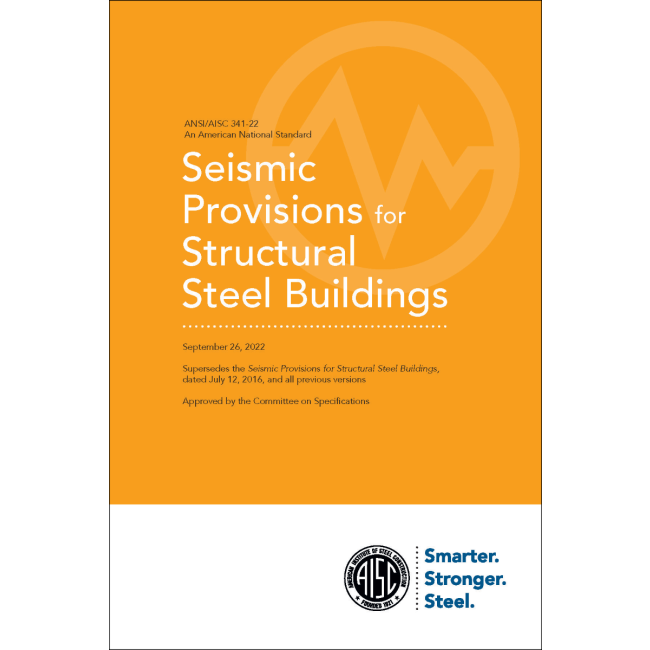

ANSI/AISC 341-22 Seismic Provisions for Structural Steel Buildings
The information presented in this publication has been prepared by a balanced committee following American National Standards Institute (ANSI) consensus procedures and recognized principles of design and construction. While it is believed to be accurate, this information should not be used or relied upon for any specific application without competent professional examination and verification of its accuracy, suitability, and applicability by a licensed engineer or architect. The publication of this information is not a representation or warranty on the part of the American Institute of Steel Construction, its officers, agents, employees, or committee members, or of any other person named herein, that this information is suitable for any general or particular use, or of freedom from infringement of any patent or patents. All representations or warranties, express or implied, other than as stated above, are specifically disclaimed. Anyone making use of the information presented in this publication assumes all liability arising from such use.
The Specification for Structural Steel Buildings (ANSI/AISC 360-22) is intended to cover common design criteria. This standard, Seismic Provisions for Structural Steel Buildings (ANSI/AISC 341-22) (hereafter referred to as these Provisions), is a separate consensus standard, to be used in conjunction with the Specification, that addresses the design and construction of structural steel and composite steel-concrete building systems specifically detailed for seismic resistance. This standard adopts Prequalified Connections for Special and Intermediate Steel Moment Frames for Seismic Applications (ANSI/AISC 358-22) by reference. ANSI/AISC 358 specifies design, detailing, fabrication, and quality criteria for connections that are prequalified in accordance with these Provisions for use with special and intermediate moment frames. While these Provisions are modified every five or six years, ANSI/AISC 358 may be processed more frequently, and newer editions of ANSI/AISC 358 may be recognized and enforced by the applicable building code. These Provisions were being developed in the same time frame as a revision of Minimum Design Loads and Associated Criteria for Buildings and Other Structures (ASCE/SEI 7-22). ASCE/SEI 7-22 is to be used concurrently with this standard for a fully coordinated package. These Provisions are the result of the consensus deliberations of a committee of structural engineers with wide experience and high professional standing, representing a wide geographical distribution throughout the United States. The committee includes approximately equal numbers of engineers in private practice and code agencies, engineers involved in research and teaching, and engineers employed by steel fabricating and producing companies. The contributions and assistance of more than 50 additional professional volunteers working in task committees are also hereby acknowledged.
| Price | $59.95 |
|---|---|
| Customer Service | We're Here To Help! Call us anytime during our customer service hours... Monday through Friday - 8:30 am to 4:30 pm (Pacific) Order Questions:
TOLL FREE, 800-273-7375 (Outside the U.S. call 818-887-7828). Our Address: 8001 Canoga Avenue Canoga Park, CA 91304 US Phone: 877-813-7145 E-mail: sales@buildersbook.com
|
| Description | The information presented in this publication has been prepared by a balanced committee following American National Standards Institute (ANSI) consensus procedures and recognized principles of design and construction. While it is believed to be accurate, this information should not be used or relied upon for any specific application without competent professional examination and verification of its accuracy, suitability, and applicability by a licensed engineer or architect. The publication of this information is not a representation or warranty on the part of the American Institute of Steel Construction, its officers, agents, employees, or committee members, or of any other person named herein, that this information is suitable for any general or particular use, or of freedom from infringement of any patent or patents. All representations or warranties, express or implied, other than as stated above, are specifically disclaimed. Anyone making use of the information presented in this publication assumes all liability arising from such use. The Specification for Structural Steel Buildings (ANSI/AISC 360-22) is intended to cover common design criteria. This standard, Seismic Provisions for Structural Steel Buildings (ANSI/AISC 341-22) (hereafter referred to as these Provisions), is a separate consensus standard, to be used in conjunction with the Specification, that addresses the design and construction of structural steel and composite steel-concrete building systems specifically detailed for seismic resistance. This standard adopts Prequalified Connections for Special and Intermediate Steel Moment Frames for Seismic Applications (ANSI/AISC 358-22) by reference. ANSI/AISC 358 specifies design, detailing, fabrication, and quality criteria for connections that are prequalified in accordance with these Provisions for use with special and intermediate moment frames. While these Provisions are modified every five or six years, ANSI/AISC 358 may be processed more frequently, and newer editions of ANSI/AISC 358 may be recognized and enforced by the applicable building code. These Provisions were being developed in the same time frame as a revision of Minimum Design Loads and Associated Criteria for Buildings and Other Structures (ASCE/SEI 7-22). ASCE/SEI 7-22 is to be used concurrently with this standard for a fully coordinated package. These Provisions are the result of the consensus deliberations of a committee of structural engineers with wide experience and high professional standing, representing a wide geographical distribution throughout the United States. The committee includes approximately equal numbers of engineers in private practice and code agencies, engineers involved in research and teaching, and engineers employed by steel fabricating and producing companies. The contributions and assistance of more than 50 additional professional volunteers working in task committees are also hereby acknowledged. |