

Electronics 2 (Quickstudy: Academic) 2019
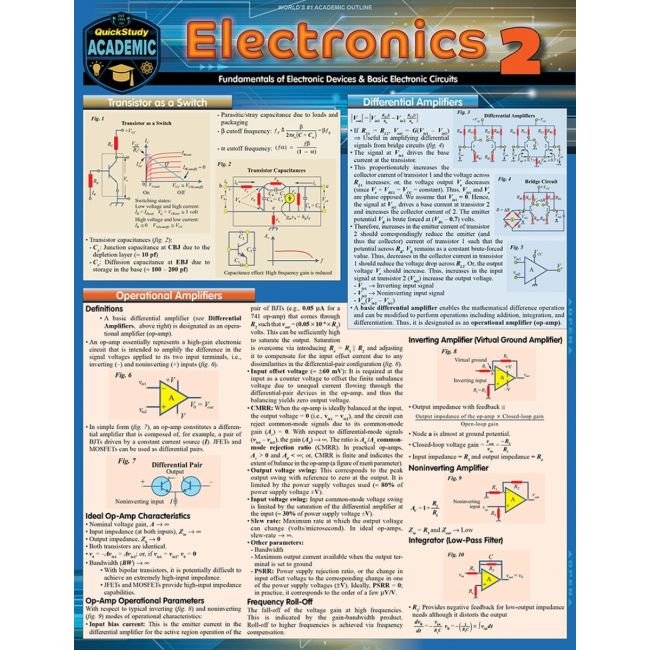
Engineers build the foundation for solid and secure systems that we all use every day. The number of facts needed for those calculations is staggering and just one mistake can wreak havoc. This must-have reference to the core fundamentals of electronics is perfect for any student or professional. Concisely written so you can have more answers in 6 durably laminated pages than you would find in 100 pages of a book. Ready at your fingertips for studying and boosting grades or for career projects in the working world, providing one more verification of facts that can ensure a solid build. Concepts covered are taught in electronic circuit courses for engineers where key facts learned need to be referenced throughout engineering school and a career. With the number of facts covered and the durability to last a lifetime, there is also no better value. To complete the set, get Electronics 2 & Electronics 1 for even more well-rounded coverage.
- Transistor as a Switch
- Differential Amplifiers
- Operational Amplifiers
- Ideal Op-Amp Characteristics
- Op-Amp Operational Parameters
- Frequency Roll-Off
- Inverting Amplifier (Virtual Ground Amplifier)
- Non-Inverting Amplifier
- Integrator (Low-pass filter)
- Differentiator (High-pass filter)
- Level Camping
- Linear Voltage-to-Current Converters
- Logarithmic Amplifier
- Charge Amplifier
- Precision Rectifier & Peak Detector
- Voltage Follower (unity gain amplifier)
- Regulated Power Supply
- Unipolar Devices Field Effect Transistors (FETs)
- FET Types, FET Operation Modes
- JFET: Device Operation
- Output Characteristics of JFET
- Linear Operation of JFET, JFET Operation
- Unipolar Devices: MOSFET
- Enhancement-Type MOSFET
- MOSFET Operation
- MOSFET output characteristics
- V-I characteristics of enhancement-type MOSFET
- Diffused-Channel (Depletion-Type) MOSFET
- Small-Signal Equivalent Circuit & Frequency Response of FETs
- Common-Gate Amplifier
- Common-Source Amplifier
- Common-Drain Amplifier
- Summary on JFETs & MOSFETs
- N-channel JFET, P-channel JFET
- N-channel Depletion MOSFET
- N-channel Enhancement MOSFET
- P-channel depletion MOSFET
- P-channel enhancement MOSFET
- Digital Electronics
- Digital Representation, Digital Circuits
- Boolean Logic & Digital Gates
- Combinational Gates
- Representation of Binary Numbers
- Implementing Logic Functions Using Switches
- Opto-Electronics
- Light Emitting Diodes
- Photodiodes & Solar Cells
- Integrated Circuits
- Complementary Metal-Oxide semiconductor
- Charge-Coupled Devices
By Barcharts.Inc
| Price | $7.95 |
|---|---|
| Customer Service | We're Here To Help Call us anytime during our customer service hours... Monday through Friday - 8:30 am to 4:30 pm (Pacific) Order Questions: TOLL FREE, 800-273-7375 (Outside the U.S. call 818-887-7828). Our Address: 8001 Canoga Avenue Canoga Park, CA 91304 US Phone: 800-275-2665 E-mail: sales@buildersbook.com
|
| Description | Engineers build the foundation for solid and secure systems that we all use every day. The number of facts needed for those calculations is staggering and just one mistake can wreak havoc. This must-have reference to the core fundamentals of electronics is perfect for any student or professional. Concisely written so you can have more answers in 6 durably laminated pages than you would find in 100 pages of a book. Ready at your fingertips for studying and boosting grades or for career projects in the working world, providing one more verification of facts that can ensure a solid build. Concepts covered are taught in electronic circuit courses for engineers where key facts learned need to be referenced throughout engineering school and a career. With the number of facts covered and the durability to last a lifetime, there is also no better value. To complete the set, get Electronics 2 & Electronics 1 for even more well-rounded coverage.
By Barcharts.Inc |