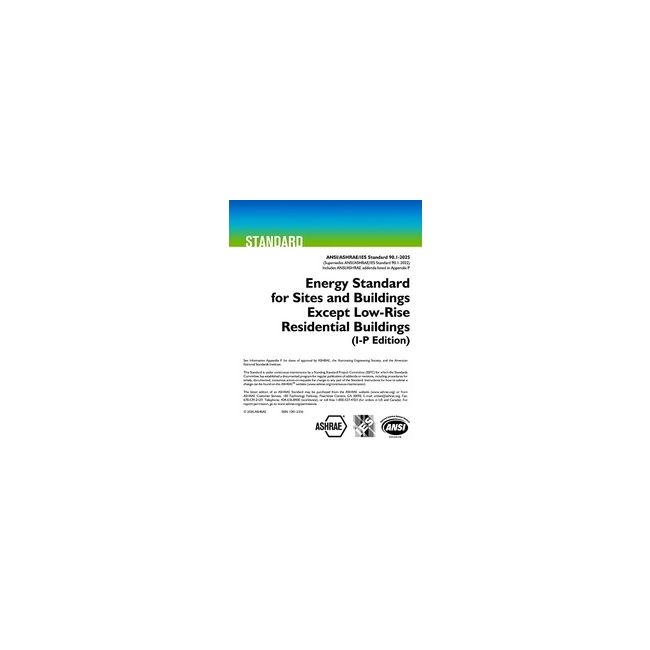

Standard 90.1-2025 (I-P Edition) Energy Standard for Sites and Buildings Except Low-Rise Residential Buildings (ANSI Approved)
Standard 90.1 has been a benchmark for commercial building energy codes in the United States, and a key basis for codes and standards around the world, for almost half a century. This standard provides the minimum requirements for energy-efficient design of most sites and buildings, except low-rise residential buildings. It offers, in detail, the minimum energy efficiency requirements for design and construction of new sites and buildings and their systems, new portions of buildings and their systems, and new systems and equipment in existing buildings, as well as criteria for determining compliance with these requirements. It is an indispensable reference for engineers and other professionals involved in design of buildings, sites, and building systems.
The 2025 edition of Standard 90.1 continues ASHRAE's efforts to improve Energy efficiency for Commercial Buildings and Sites. The standard incorporates 105 addenda that advance levels of energy efficiency, expand options for compliance, and better align with industry practice and related ASHRAE standards.
Overall Organization and Structure
- Revised, more consistent flowcharts that better illustrate key system requirements
- Online access to climate zone tables via a free-to-read version of Standard 169
- Updated and added new supporting tools
- Updated normative and informative references
Enforcement and Compliance (Section 4)
- Unified and simplified terminology for jurisdictional authority
- Clarified commissioning requirements
- Updated building performance factors (BPF) for use with Appendix G
Building Envelope (Section 5)
- Updated insulation levels for opaque elements (walls, roofs, and floors) and fenestration (windows and skylights) to increase envelope stringency
- Clarified fenestration provisions to allow for performance impacts at high elevations
- New requirements for the proper installation of rigid insulation boards
- Updated methodology for calculating effective U-factors for steel-framed walls and where continuous insulation is interrupted
Mechanical (Sections 6 and 7)
- Increased minimum efficiency requirements for a wide range of equipment to reflect the latest federal test procedures and industry rating standards for products that include unitary systems, water-source heat pumps, cooling towers, fans, and dedicated outdoor air systems
- Changes aligned with industry efforts to move to annualized metrics that focus more on average annual efficiency:
- New metrics for unitary products with the new IVEC cooling annualized metric, and a new annualized metric for heat pumps with an IVHE for warmer climates and IVHEC for cold climates
- A new IEER for water-source heat pumps
- Integrated DOE regulated products tables to improve presentation
- Added a procedure for fan system power limits emphasizing distribution system efficiency
- Revised pool heating provisions to prioritize recovered and renewable heat sources before conventional heating methods are engaged
- Added provisions for gas-fired heat pumps and gas-fired heat pump-water heaters to meet prescriptive requirements and qualify for energy credits
- Updated dehumidification and ventilation requirements to align with ANSI/ASHRAE Standard 62.1
Power and Lighting (Sections 8 and 9)
- Introduced new provisions for electric vehicle spaces, receptacle controls, and energy monitoring
- Where direct digital control systems are installed, added a requirement for data to be graphically displayed to encourage effective monitoring of building energy use
- Restructured lighting requirements to clearly distinguish lighting power density limits from control requirements, and updated interior and exterior lighting power density values
- Revised decorative and specialty lighting values to reflect widespread LED adoption
- Revised exterior lighting zones to align with current IES guidance
- Strengthened control requirements through expanded daylight-responsive controls, updated occupancy provisions, and revised thresholds that trigger automatic control requirements
Renewable Energy (Section 10)
- Expanded and clarified renewable energy provisions, including higher minimum prescriptive on-site renewable capacity requirements based on an updated cost-effectiveness analysis, and the introduction of limited off-site renewable energy compliance options by climate zone
Energy Credits (Section 11)
- Improved flexibility and performance-oriented structure of energy credit framework
- Added new credits for system-level strategies, including use of the Mechanical System Performance Rating Method (TSPR) and thermal energy storage for both heating and cooling
- Increased the overall number of credits required by building type based on updated analyses that considered real-world performance factors
Energy Cost Budget (ECB) (Section 12)
- Refined the ECB compliance path to improve consistency with prescriptive requirements
- Updated modeling rules to align envelope, mechanical, and lighting assumptions in the budget building more closely with Section 5, 6, and 9 requirements
- Added requirements that, where available, actual utility rates or contractual energy prices must be used instead of generic national averages
- Altered modeling of fan power in baseline systems due to changes in equipment efficiency metrics and rating conventions
- Further refined ECB requirements with respect to building orientation, shading assumptions, and treatment of renewable energy
Appendix G--Performance Rating Method
- Made significant updates to reinforce Normative Appendix G as a stable, transparent performance baseline, while accommodating modern design approaches
- Expanded and refined baseline HVAC system definitions, including new distinctions based on heating source and updated zoning and economizer rules
- Revised modeling requirements for elevators, dehumidification, ventilation, and purchased heating and cooling to better reflect measured energy use and current international standards
- Updated simulation software requirements to align with the latest version of ASHRAE Standard 140
- Replaced references to specific simulation tools with performance-based qualification criteria
- Updated building performance factors in consideration of the energy efficiency improvements introduced since the last edition
| Price | $220.95 |
|---|---|
| Customer Service | We're Here To Help Call us anytime during our customer service hours... Monday through Friday - 8:30 am to 4:30 pm (Pacific) Order Questions:
TOLL FREE, 800-273-7375 (Outside the U.S. call 818-887-7828). Our Address: 8001 Canoga Avenue Canoga Park, CA 91304 US Phone: 800-275-2665 E-mail: sales@buildersbook.com
|
| Description | Standard 90.1 has been a benchmark for commercial building energy codes in the United States, and a key basis for codes and standards around the world, for almost half a century. This standard provides the minimum requirements for energy-efficient design of most sites and buildings, except low-rise residential buildings. It offers, in detail, the minimum energy efficiency requirements for design and construction of new sites and buildings and their systems, new portions of buildings and their systems, and new systems and equipment in existing buildings, as well as criteria for determining compliance with these requirements. It is an indispensable reference for engineers and other professionals involved in design of buildings, sites, and building systems. The 2025 edition of Standard 90.1 continues ASHRAE's efforts to improve Energy efficiency for Commercial Buildings and Sites. The standard incorporates 105 addenda that advance levels of energy efficiency, expand options for compliance, and better align with industry practice and related ASHRAE standards. Overall Organization and Structure
Enforcement and Compliance (Section 4)
Building Envelope (Section 5)
Mechanical (Sections 6 and 7)
Power and Lighting (Sections 8 and 9)
Renewable Energy (Section 10)
Energy Credits (Section 11)
Energy Cost Budget (ECB) (Section 12)
Appendix G--Performance Rating Method
|