|

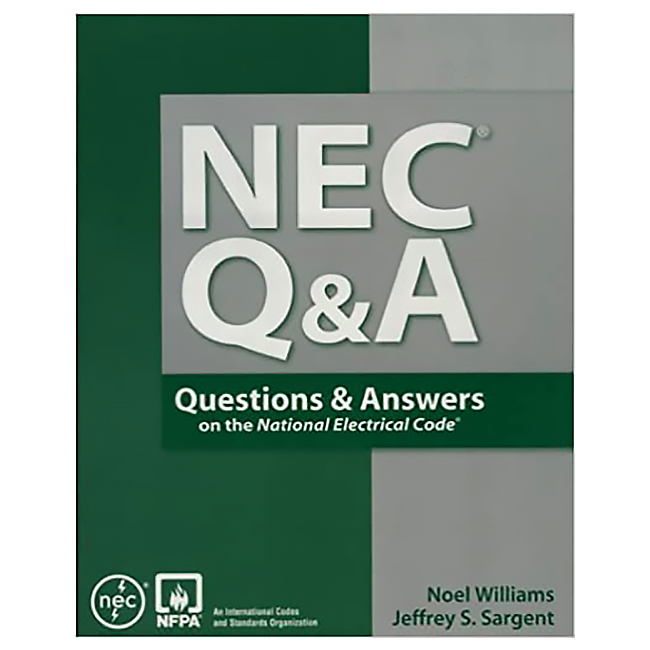

NEC(r) Q&A: Questions and Answers on the National Electrical Code(r) by Noel Williams
was $78.95 Special Price $71.05
Availability:
In stock
Product Code
0763744735
Beginners will find answers to practical on-the-job problems, and experts will be able to explore in depth the reasons behind NEC rules and the additional issues related to each question in this examination of frequently- and not-so-frequently-asked questions. Based on questions posed to, and answered by, NFPA's Advisory Services engineers.
Includes coverage of:
- Where GFCI, AFCI, and overcurrent protection are required.
- Parallel paths and objectionable current over grounding connectors.
- Ampacity calculations coordinated with termination and continuous load requirements.
- How to use dual-marked wiring cables.
- Use of cable trays permitted in other than industrial occupancies.
- Low-voltage lighting systems.
- Overcurrent protection requirements for motors.
- Classification of hazardous locations.
- Definition of Class 1, 2, and 3 remote-control, signaling, and power-limited circuits.
| Price | $78.95 |
|---|---|
| Customer Service | Customer ServiceWe're Here To Help Call us anytime during our customer service hours... Monday through Friday - 8:30 am to 4:30 pm (Pacific) Order Questions: TOLL FREE, 800-273-7375 (Outside the U.S. call 818-887-7828). Our Address: 8001 Canoga Avenue Canoga Park, CA 91304 US Phone: 800-275-2665 E-mail: sales@buildersbook.com
|
| Description | Beginners will find answers to practical on-the-job problems, and experts will be able to explore in depth the reasons behind NEC rules and the additional issues related to each question in this examination of frequently- and not-so-frequently-asked questions. Based on questions posed to, and answered by, NFPA's Advisory Services engineers.
Includes coverage of:
|