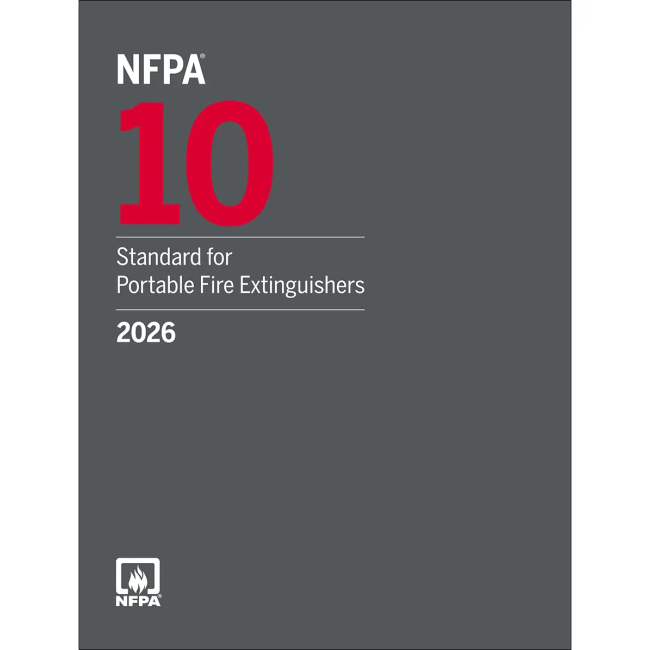

Portable fire extinguishers are a critical first line of defense against small fires when used by trained personnel. For the best protection, be sure to select, use, and maintain extinguishers using the latest requirements in the most up-to-date edition of NFPA 10, Standard for Portable Fire Extinguishers. You can depend on this important standard for comprehensive rules for the distribution, placement, operation, and inspection of portable fire extinguishers, as well as rules for testing and recharging.
|
NFPA 10, Standard for Portable Fire Extinguishers
was $219.95 Special Price $197.95
Availability:
In stock
Product Code
NFPA10
The 2026 edition features several significant updates, including:
- New definition of foam to capture all chemical-based forms, replacing aqueous film-forming foam (AFFF), film-forming fluoroprotein foam (FFFP), and synthetic fluorine-free foam (SFFF)
- Expanded Chapter 5 Annex A material to clarify what types of equipment should and should not be considered delicate electronic equipment
- Added Chapter 7 requirements to allow for a performance-based inspection program that can extend or reduce the frequency of fire extinguisher inspections
- New condemned extinguisher requirements in Chapter 8 that clarify the proper disposal procedures of non-specific cylinders not addressed in Department of Transportation (DoT) or Transport Canda (TC) regulations
Table of Contents
Chapter 1 Administration1.1 Scope.
1.2 Purpose.
1.3 Units.
Chapter 2 Referenced Publications2.1 General.
2.2 NFPA Publications.
2.3 Other Publications.
2.4 References for Extracts in Mandatory Sections.
Chapter 3 Definitions3.1 General.
3.2 NFPA Official Definitions.
3.3 General Definitions.
3.4 Fire Extinguisher Definitions.
Chapter 4 General Requirements4.1 Listing and Labeling.
4.2 Identification of Contents.
4.3 Instruction Manual.
4.4 Obsolete Fire Extinguishers.
Chapter 5 Selection of Portable Fire Extinguishers5.1 General Requirements.
5.2 Classifications of Fires.
5.3 Extinguisher Classification System.
5.4 Classification of Hazards.
5.5 Selection of Fire Extinguishers.
Chapter 6 Installation6.1 General.
6.2 Installations for Class A Hazards.
6.3 Installations for Class B Hazards.
6.4 Installations for Class C Hazards.
6.5 Installations for Class D Hazards.
6.6 Installations for Class K Hazards.
6.7 Solid-Fuel Cooking Appliances.
Chapter 7 Inspection, Maintenance, and Recharging7.1 General.
7.2 Inspection.
7.3 Extinguisher Maintenance.
7.4 Carbon Dioxide Hose Assembly Conductivity Test.
7.5 Hose Station Maintenance.
7.6 Electronic Monitoring System Maintenance.
7.7 Maintenance of Wheeled Extinguisher Hoses and Regulators.
7.8 Extinguisher Recharging and Extinguishing Agents.
7.9 Pressure Gauges.
7.10 Cabinets.
7.11 Maintenance of Signage.
7.12 Prohibition on Uses of Extinguishers and Conversion of Fire Extinguisher Types.
7.13 Maintenance and Recharge Service Collar.
7.14 Weight Scales.
Chapter 8 Hydrostatic Testing8.1 General.
8.2 Test Equipment.
8.3 Frequency.
8.4 Extinguisher Examination.
8.5 Testing Procedures.
8.6 Test Pressures.
8.7 Recording of Hydrostatic Tests.
8.8 Condemning Extinguishers.
Annex A Explanatory Material
Annex B Recommended Markings to Indicate Extinguisher Suitability According to Class of Fire
Annex C Fire Extinguisher Selection
Annex D Operation and Use
Annex E Distribution
Annex F Selection of Residential Fire-Extinguishing Equipment
Annex G Extinguisher Classification and Rating System
Annex H Conditions of Selection
Annex I Maintenance Procedures
Annex J Typical Specification of Equipment Capable of Producing Dry Air
Annex K Informational References
2026 (9781455932030)
2022 (9781455927791)
2018 (9781455916597)
2002 (NFPA10)
| Price | $219.95 |
|---|---|
| Customer Service | We're Here To Help! Call us anytime during our customer service hours... Monday through Friday - 8:30 am to 4:30 pm (Pacific) Order Questions:
TOLL FREE, 800-273-7375 (Outside the U.S. call 818-887-7828). Our Address: 8001 Canoga Avenue Canoga Park, CA 91304 US Phone: 800-275-2665 E-mail: sales@buildersbook.com
|
| Description | Portable fire extinguishers are a critical first line of defense against small fires when used by trained personnel. For the best protection, be sure to select, use, and maintain extinguishers using the latest requirements in the most up-to-date edition of NFPA 10, Standard for Portable Fire Extinguishers. You can depend on this important standard for comprehensive rules for the distribution, placement, operation, and inspection of portable fire extinguishers, as well as rules for testing and recharging. The 2026 edition features several significant updates, including:
Table of Contents Chapter 1 Administration1.1 Scope. Chapter 2 Referenced Publications2.1 General. Chapter 3 Definitions3.1 General. Chapter 4 General Requirements4.1 Listing and Labeling. Chapter 5 Selection of Portable Fire Extinguishers5.1 General Requirements. Chapter 6 Installation6.1 General. Chapter 7 Inspection, Maintenance, and Recharging7.1 General. Chapter 8 Hydrostatic Testing8.1 General. Annex A Explanatory Material 2026 (9781455932030) 2022 (9781455927791) 2018 (9781455916597) 2002 (NFPA10) |